




How much room do you need for a golf simulator?
Get dimensions and planning tips.
 Trackman Editorial Team
The first question most people ask about getting a golf simulator is not about ball flight or club data. It’s about walls, ceilings and tape measures. How much room do you actually need?
If you're still deciding which Trackman golf simulator is right for your space, the overview covers everything from hardware options to software and full build-outs.
A simulator is not just a screen and a launch monitor. It’s a hitting environment, and the quality of that environment shapes everything that follows. Swing freely and the data tends to behave. Feel constrained and the swing adapts, often in ways the golfer doesn’t notice but the numbers certainly do.
What follows is a clear, experience-based look at golf simulator space requirements, with specific guidance for both Trackman iO and Trackman 4. The goal is not to sell a fantasy of “any room will do,” but to explain what actually works, why it works, and where compromises begin to show up in the data.
Understanding golf simulator space requirements
At its core, a golf simulator room needs to do three things well:
Allow the golfer to swing naturally
Provide enough ball flight for accurate measurement
Keep people and property safe
Everything else—projectors, lighting, sound, turf—is secondary to those fundamentals.
It helps to think in terms of minimum versus optimal space. Minimum dimensions describe what is technically possible. Optimal dimensions describe what feels like golf.
A room can meet the minimum and still feel tight. It can also exceed the minimum and suddenly feel generous, even if the tape measure hasn’t moved much. That difference is often just a foot here or there, especially in ceiling height and width.
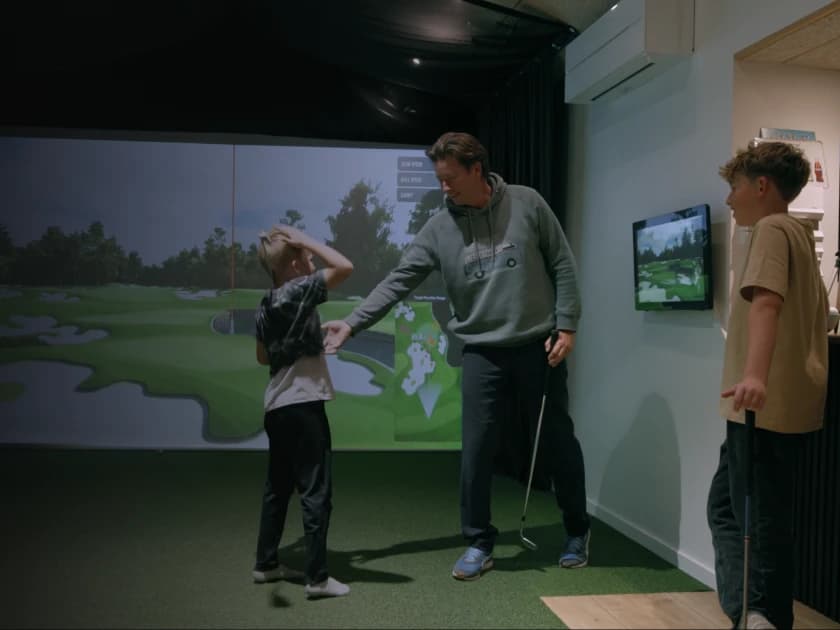
Another consideration is who will be using the space. A single right-handed golfer has very different needs than a commercial bay designed for right- and left-handed players rotating through all day. The simulator doesn’t know the difference, but the room certainly does.
Ceiling height
Ceiling height is the most common limitation, and the hardest one to fix after the fact.
For most golfers, 3.0 meters (10 feet)+ is the practical minimum to swing comfortably. That number assumes a reasonably neutral swing and a modern driver length. Taller players, players with very upright swings, or anyone who tends to add a little extra speed indoors will benefit from more.
The issue isn’t just physical clearance. It’s psychological. When a golfer is even slightly aware of the ceiling, the swing changes. The change may be subtle, but it can show up several metrics like speed, attack angle and dynamic loft.
From a measurement standpoint, ceiling height also matters for the technology itself, particularly with ceiling-mounted systems. Radar geometry depends on clear space, not just swing clearance.
Width
Width is often underestimated because it’s less obvious than ceiling height. But narrow rooms quietly shape behavior.
For a single golfer, 4.6 meters (15 feet)+ of width is a strong benchmark. This allows the player to stand comfortably, swing without feeling boxed in, and accommodate both right- and left-handed play if needed.
In narrower rooms, golfers tend to shift their setup, sometimes without realizing it. Feet creep inward. Ball position drifts. The swing adapts to the walls. Over time, this affects both performance and confidence.
For commercial installations or shared spaces, width becomes even more important. It supports dual dexterity, safer movement around the hitting area, and a general sense that the bay belongs to the golfer while they’re in it.
Depth
Depth ties everything together: ball flight, player position, screen safety and launch monitor placement.
A simulator needs enough distance from the hitting position to the impact screen for the ball to launch, fly, and be captured accurately before impact. It also needs space behind the screen for safety and energy absorption.
The exact requirement depends on the tracking technology in use, which is where the distinction between Trackman 4 and Trackman iO becomes meaningful. You can compare both options in full on the Trackman golf simulator page.
Space recommendations for Trackman iO
Trackman iO changes the conversation about space because of how it measures the shot.
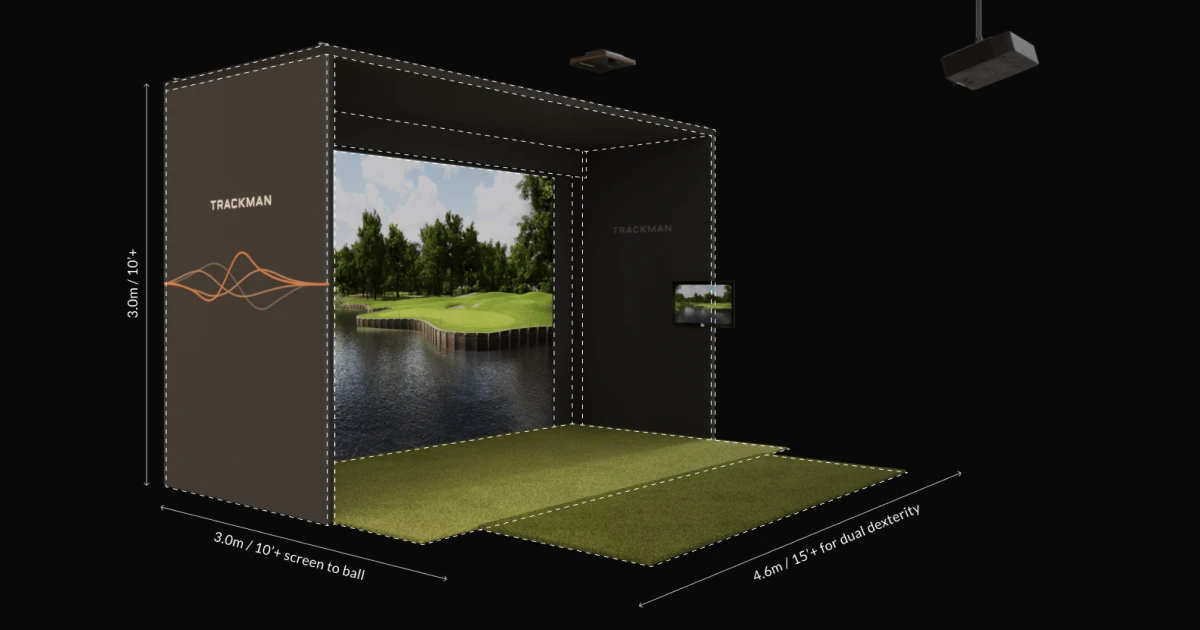
Using a ceiling-mounted design and a combined tracking system, Trackman iO focuses on the strike and the earliest part of ball flight. The result is a system that does not require long distances behind the player, which immediately opens up more rooms as viable simulator spaces.
Recommended dimensions for Trackman iO
Ceiling height: 3.0 m / 10 ft +
Room width: 4.6 m / 15 ft +
Screen to ball: 3.0 m / 10 ft +
Behind the ball: Enough for a comfortable swing
Is your space narrower than the recommended 4.6 meters?
Get in touch with a representative to hear how the Trackman iO Duo might be more suitable for a smaller setup.
These numbers describe a room where the system performs consistently. The depth recommendation includes space for the impact screen and enough ball flight to stabilize launch and spin measurements. You just need to add enough space to the hitting area behind the ball for the swing to feel natural.
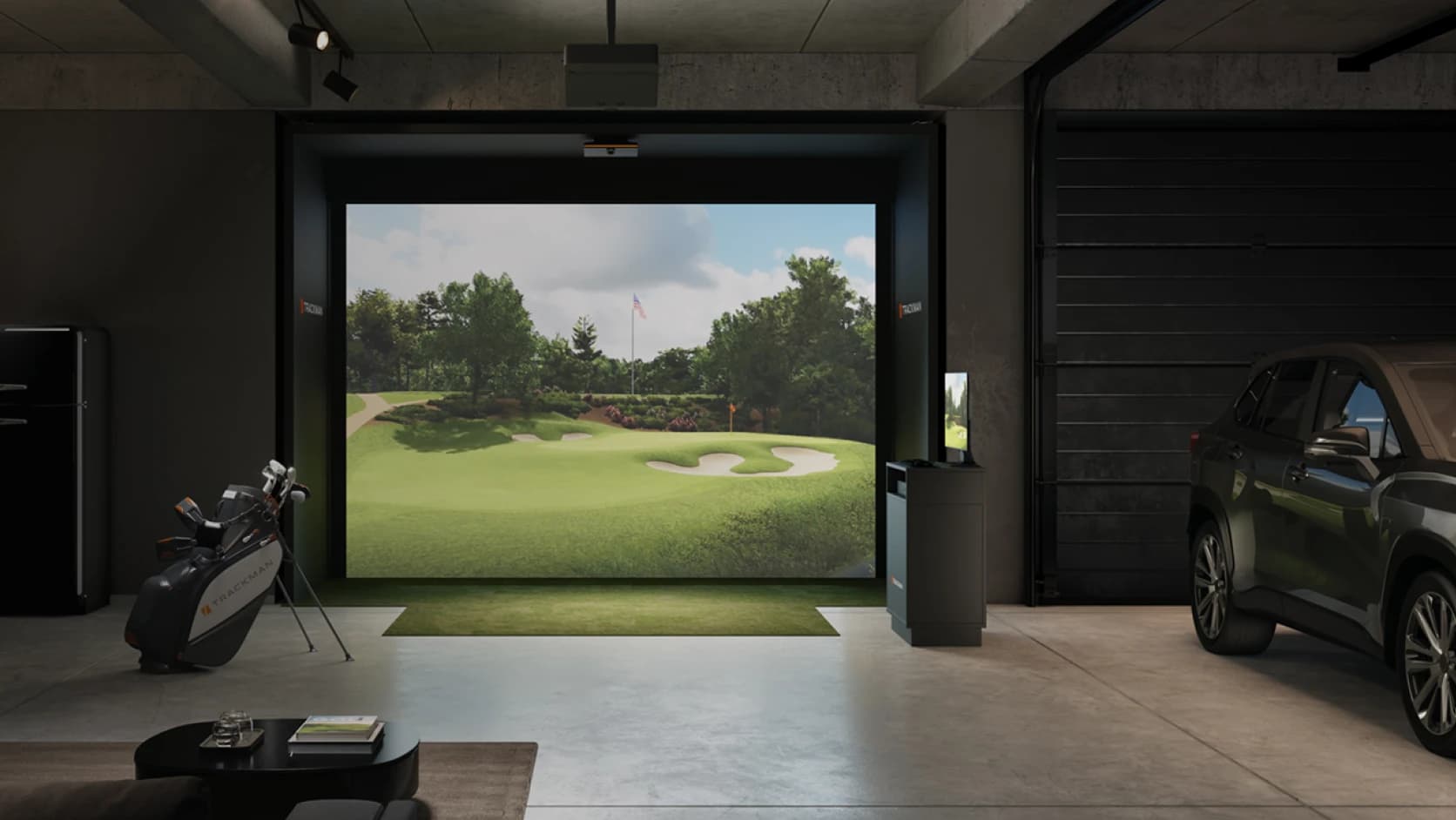
One of the practical advantages of Trackman iO is how the technology doesn't intrude into the room. There is no unit behind the player, no floor-mounted hardware to work around. When installed correctly, the system disappears into the ceiling, leaving the golfer alone with the ball, the club and the shot.
This is why it’s fair to say that, with Trackman iO, the primary requirement is enough room to comfortably swing the club. The technology adapts to the space rather than demanding that the space adapt to the technology.
Space recommendations for Trackman 4
Trackman 4 approaches the problem from a different angle, quite literally.
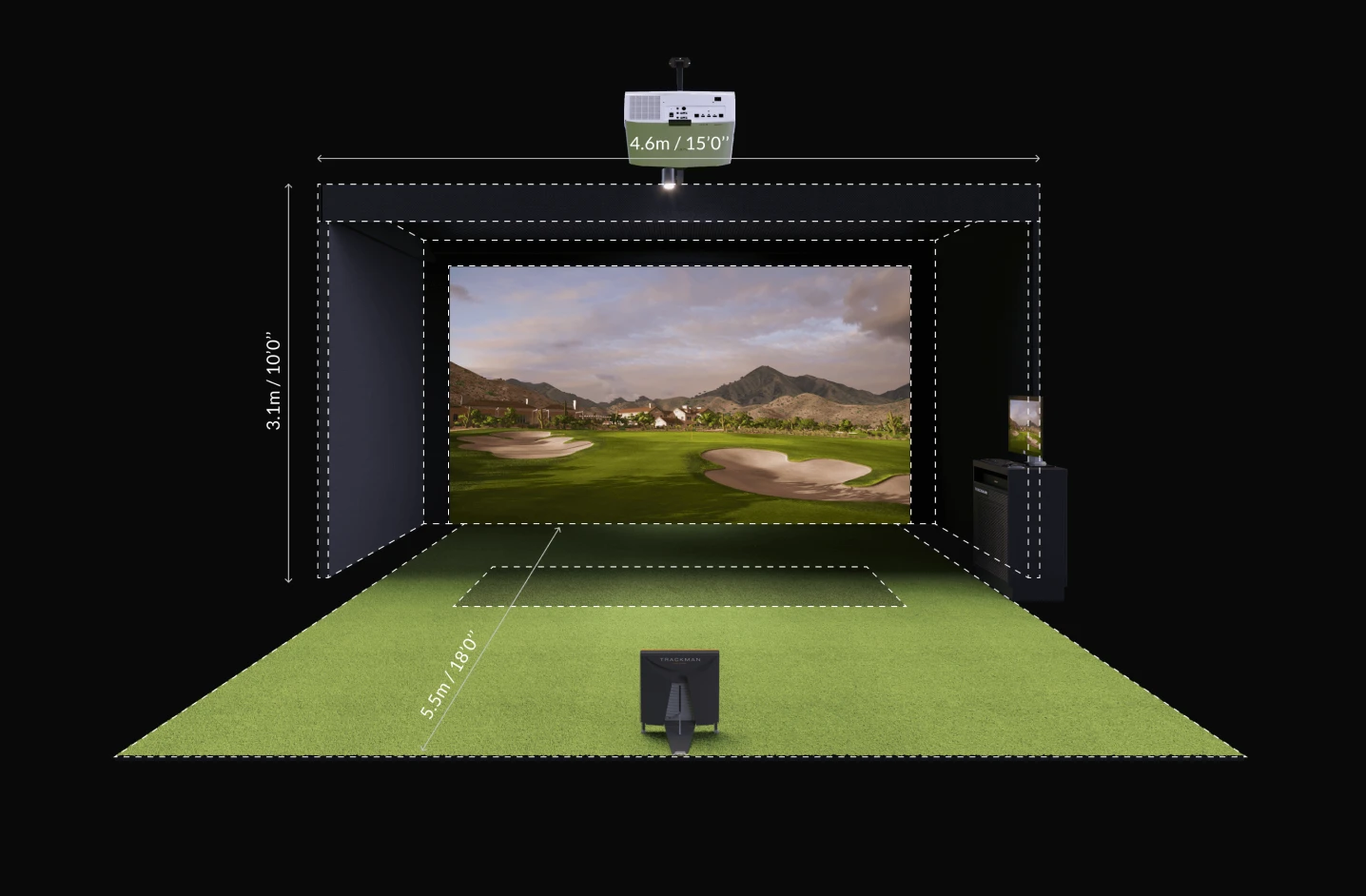
As a behind-the-ball radar system, Trackman 4 tracks the full flight of the golf ball from impact forward. To do that accurately indoors, it needs space both in front of and behind the hitting position.
Recommended dimensions for Trackman 4
Ceiling height: 3.0 m / 10 ft +
Room width: 4.6 m / 15 ft +
Screen to unit distance: 5.5 m / 18 ft +
The key distinction here is that Trackman 4 requires space behind the ball for radar tracking. That space is not optional if accuracy is the priority. Reducing it can introduce inconsistencies, especially with higher-speed shots.
In return, Trackman 4 delivers full-flight radar tracking that closely mirrors outdoor conditions and includes a larger suite of metrics. For players who prioritize continuity between indoor and outdoor data, or for teaching and fitting environments where more metrics are essential, the space requirement is a worthwhile trade-off.
As with iO, ceiling height remains critical. Ten feet is the practical floor, not a luxury. More height improves comfort, confidence, and long-term usability.
For a detailed look, check our guide to golf simulator.
Fitting a simulator into a small space
Not every simulator room is ideal, and many excellent setups live in basements, garages, or converted rooms that started with compromises.
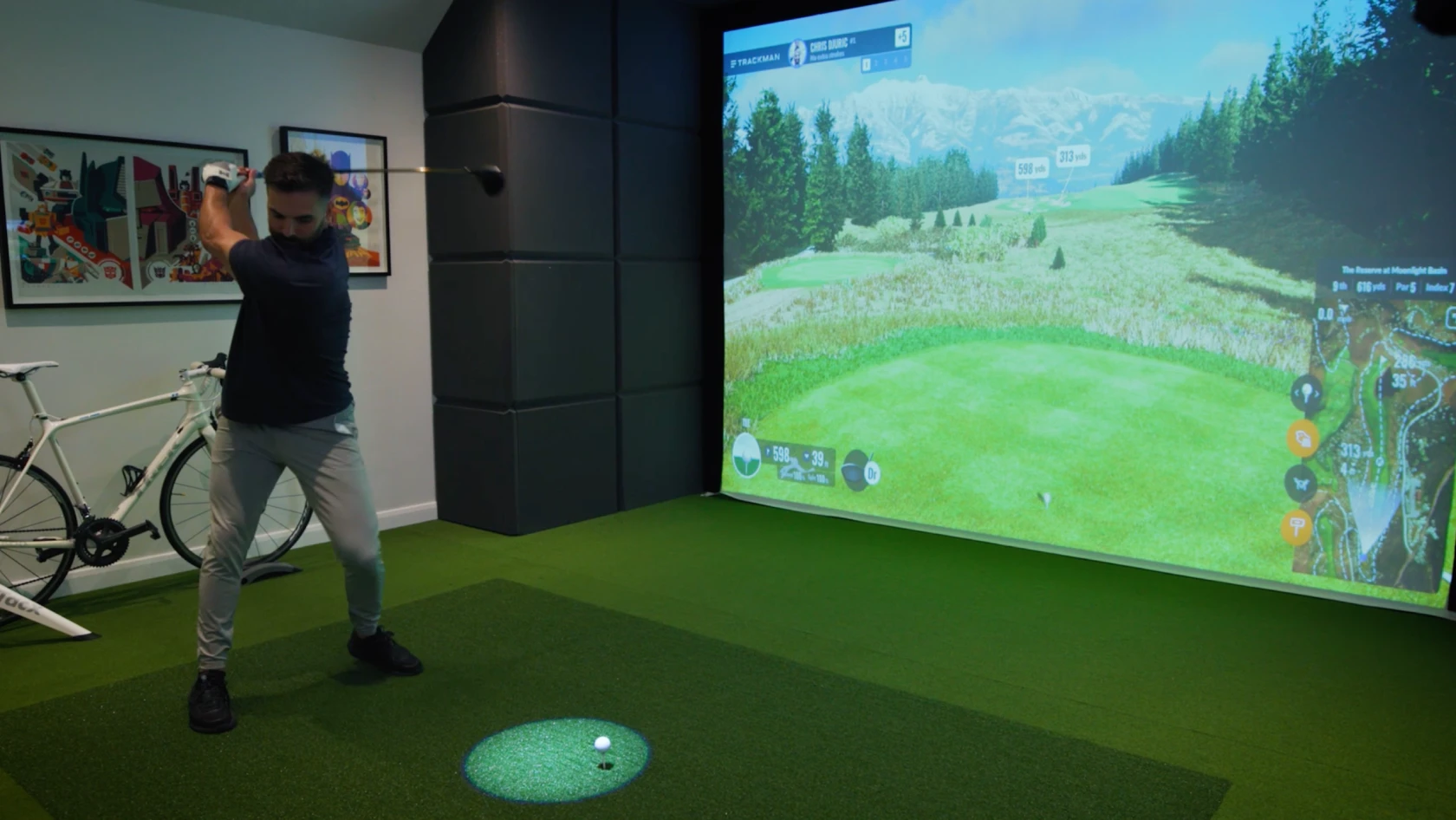
If space is tight, the most important step is testing. Take your longest club and make full swings in the room before committing to equipment. Do it slowly at first, then at speed. Pay attention not just to clearance, but to how the swing feels.
Safety matters more in small spaces. Impact screens should be properly rated. Side netting and ceiling protection can prevent damage and provide peace of mind, especially when guests or less experienced players use the simulator.
Tips for measuring and testing your space
Start with a tape measure and write everything down. Height, width, depth, obstructions, lighting fixtures.
Swing. Slowly at first, then at speed. Use the clubs you actually play, particularly the longer ones.
Remove temporary obstacles where possible. Even small changes—moving a light, covering a window, adjusting a door swing—can unlock a workable solution.
Offset hitting positions can help in narrower rooms, allowing the golfer to stand slightly off-center while still hitting into the middle of the screen. This is common in smaller installations and works well when done deliberately rather than as an afterthought.
Additional setup considerations
Space doesn’t stop with the walls.
Projector placement needs to align with both screen size and throw distance. Poor placement can create shadows or force awkward mounting solutions.
Lighting should be even and controlled. Too much light washes out the image. Too little makes the room feel artificial and fatiguing.
Ventilation is often overlooked but matters in enclosed spaces, particularly in commercial installations where multiple golfers cycle through the room.
Finally, comfort matters. Flooring, sound treatment, and simple seating can turn a technically correct simulator into a place people actually want to spend time.
Planning commercial simulator spaces
Commercial environments magnify every space decision.
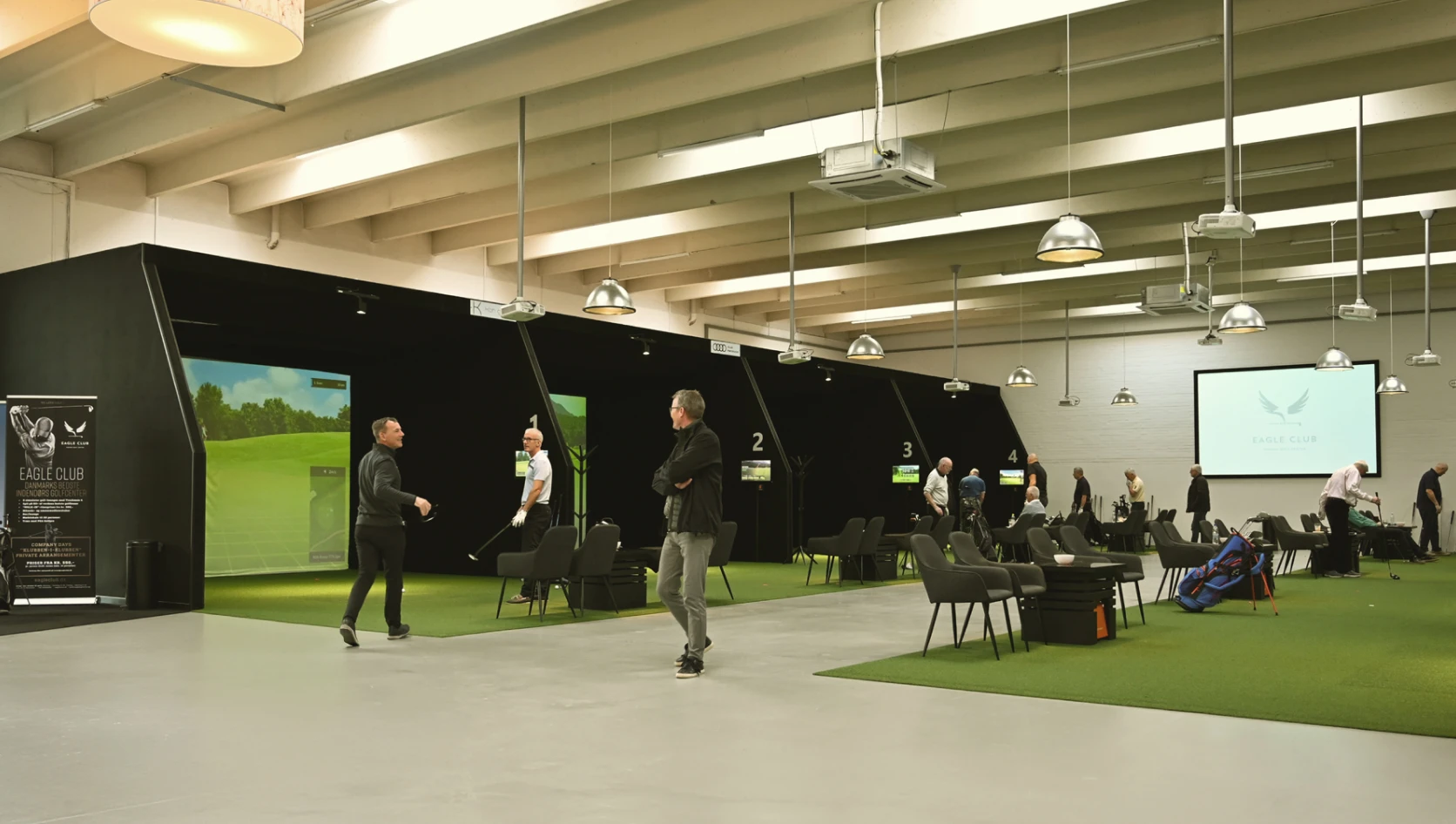
Multiple bays require buffer zones, not just for safety but for flow. Players move, clubs swing and staff circulate. Tight layouts increase wear and reduce longevity.
Ceiling height should be generous whenever possible. It protects against mishits, accommodates all swing types, and future-proofs the space as equipment evolves. Width becomes non-negotiable in commercial settings, particularly when dual-dexterity use is expected. A room that works for one golfer may not work for a steady stream of them.
Our Success Stories show how Trackman works with facilities to create the best simulator spaces and experiences.
Living with a simulator day to day
It’s easy to talk about room dimensions and equipment placement in abstractions. It’s more useful, and more motivating, to hear what happens when a simulator becomes part of someone’s actual golf life.
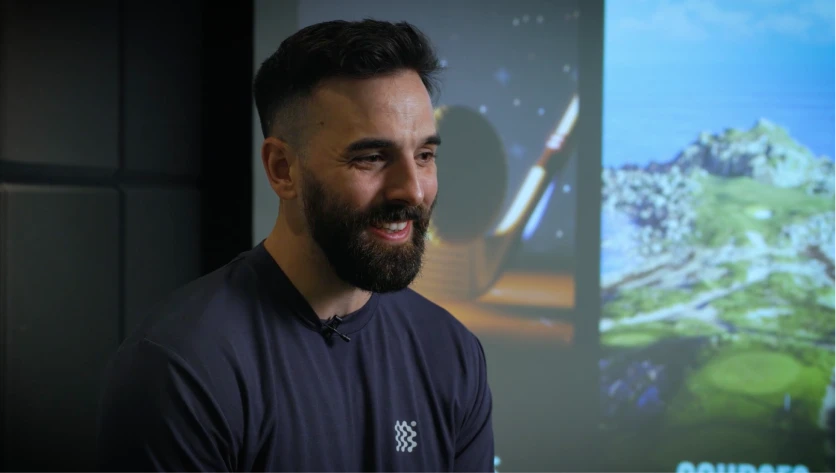
In the video below, Chris Djuric walks through why he decided to build his setup, what he expected to use it for, and what surprised him once it was in. The details are personal, but the pattern is familiar: more swings with feedback, clearer practice intentions, and a game that starts to travel better from indoors to the course.
Watch the video and get the full story here
Choosing the right Trackman setup
The right simulator is not just about budget or features. It’s about fit.
Trackman iO excels in rooms where ceiling mounting is possible and depth behind the player is limited. Trackman 4 thrives in spaces that can accommodate behind-the-ball tracking and longer flight observation.
Both systems deliver Tour-level data when installed in spaces that respect their requirements.
Ready to go further? The Trackman golf simulator page walks through the complete system — hardware, software, and space — in one place.
Use Trackman Sim Builder to plan your space
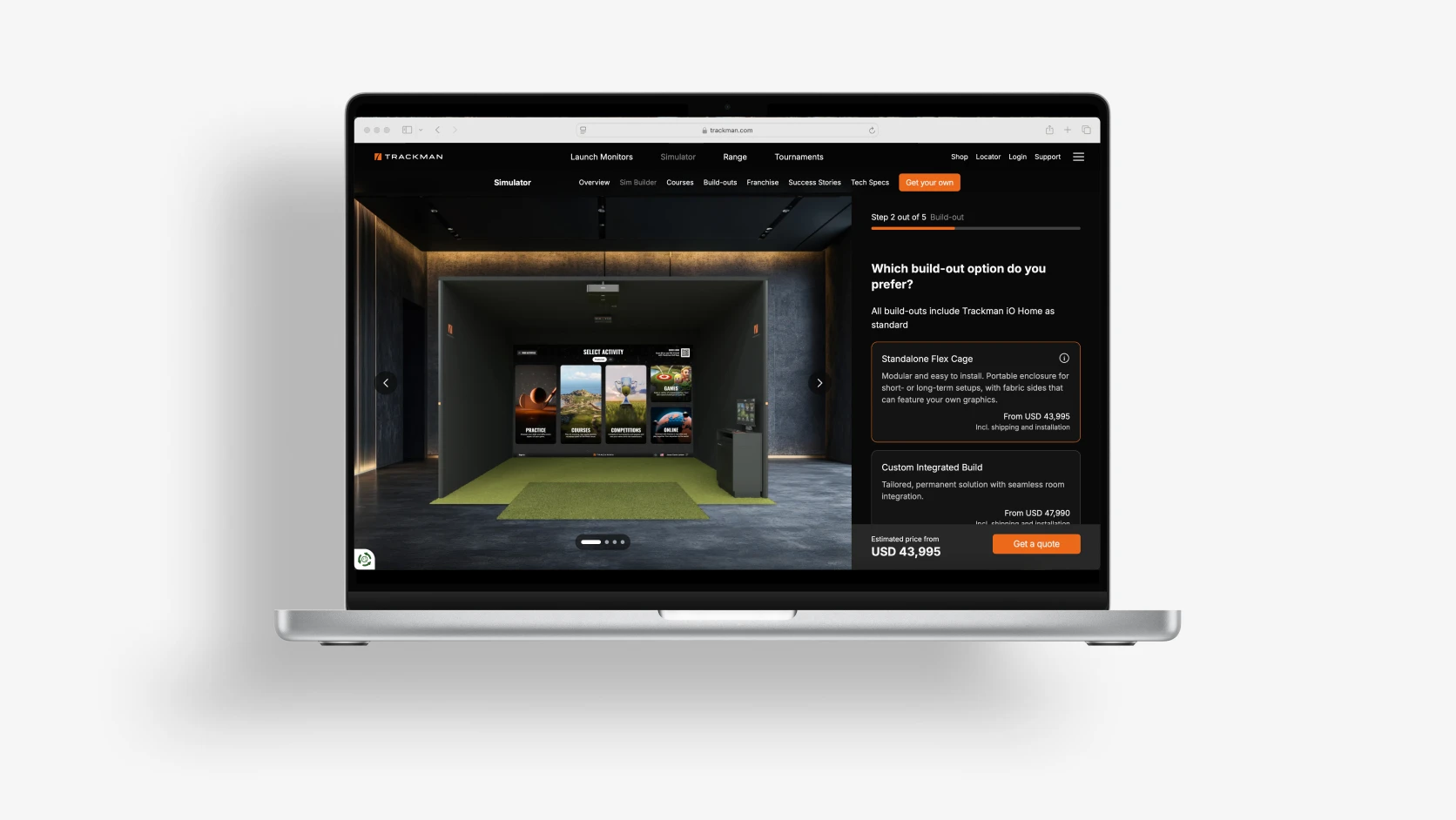
Whether you’re planning a built-in custom simulator that disappears into the room, or a stand-alone cage setup you can install and adjust as you go, Trackman Sim Builder helps you map the project before you commit.
Add your room dimensions, then explore different tech setups, software configurations, and pricing quote options to match your space, your goals, and the way you actually want to use the sim.
Try Trackman Sim Builder and turn “will it work?” into a plan.
For guidance on how to use our Sim Builder feature, check out this article.
FAQ
How big of a room do you need for a golf simulator?
Most golfers are comfortable starting around 10 feet of ceiling height, 15 feet of width, and 18 feet of depth, depending on the system used. But some systems, like the Trackman iO, allow for great setups in smaller spaces.
Is a 12 × 12 room big enough?
It may allow short-iron swings, but most players will feel constrained, especially with the driver. And for some tech setups, this room is simply too small.
Can you use a simulator with 8-foot ceilings?
In rare cases and with modified swings, yes. For full swings and long-term use, it’s not recommended.
How do you protect your ceiling?
Rated impact netting, proper club testing, and sufficient clearance are the best safeguards.
A good simulator room doesn’t announce itself. It simply lets the golfer swing, watch the ball fly, and trust what the numbers say. When the space is right, the technology fades into the background, which is exactly where it belongs.